

Pozole recipe
- iliarili13
- Oct 12, 2021
- 6 min read
From north to south, each Mexican family has its own recipe for this traditional Mexican soup.
For parties, weddings, holidays, posadas, or any occasion, pozole is an essential classic of Mexican Gastronomy. I remember that as a child I visited my best friend's house once and her sister suddenly arrived telling us: "Doña Dolores prepared pozoles, let's go for a little". I felt shy because I did not know her or anyone else in the area. Upon arrival it seemed that they were preparing a party, the neighbors had brought music, snacks, drinks, chairs, and more. That day I discovered that pozole does not need a special occasion. Pozole is the special occasion. In the most traditional neighborhoods of Mexico, when a neighbor prepares pozole, it is well known that everyone is invited. Whether you know the host or not, pozole means that the doors of a house are open and there is a bowl ready for you.

The origins of Pozole:
The word "Pozole" comes from the words "Pozol" and "Posoli" in the indigeneous language, Nahuatl Pozolli. Pozol means foamy, and Posoli is a verb which means to cook corn. It is a dish that is identified by the large grain of white corn, it has meat, vegetables, sauces, and endless toppings.
Pozole had its pre-hispanic origin before the Spanish Conquest of the indigenous peoples of Mexico. According to the book "Advances in food science and technology in Mexico", in chapter six entitled: "The pozole, current and traditional situation", it is mentioned that the story goes back to the Spanish invasion. Bernardino de Sahagun, a Friar, mentions indigenous ceremonies within his writings in honor of Xipe Totec, the Aztec god of spring and regeneration. In these festivities, corn is cooked with the meat of the warriors sacrificed in the solar rites. This fact is supported by anthropologists who were collecting various recipes from Spanish friars. These recipes showed that human remains were cooked with corn. However, with the mixture of cultures and the eradication of indigenous traditions, human meat was soon replaced by pork since they have a terribly similar flavor (not that I would know).
Interesting or creepy?
Over the years, a dish that was part of a ritual to demonstrate courage and honor to the gods became one of the most typical foods of Mexican families. The pozole has different versions, the most classic are red, white, and green, (like the national flag), and one of my favorites is seafood, but this is only traditional from the coast. Corn is currently considered by the UN as part of the intangible heritage of Mexico to the world, so the value of this dish is incalculable that it has been consumed for more than 3000 years. Today I will bring you my family recipe to celebrate my roots and share one of my favorite soups, Red Pork Pozole.

Ritual cannibalism among the Mexica people in the Aztec empire. Drawing from Codex Magliabechiano mid-16th century.
Red Pork Pozole Recipe:
PREP TIME: 30 mins
COOK TIME: 4 hrs
TOTAL TIME: 4 hrs 30 mins
SERVINGS 12 servings Ingredients:
6pc dried guajillo and ancho
Salt to taste
1 large (3 kg) can white pozole corn
2kg s pork shoulder (preferably with bone), cut into 4cm cubes. Can also use pork shanks, Pork feet and Pork backbone.
200gr Pork belly.
3 tablespoons of Pork fat
12 garlic cloves
3 pc tomatoes
2 pc onion
3 bay leaves
1 teaspoon ground cumin
1 teaspoon ground pepper
2 tablespoons of dry oregano
Salsa de Cacahuate / Peanut sauce:
7 – 12 pc of chile de arbol peppers
5 garlic cloves
1/2 cup sesame seeds
1 cup peanuts
1 cup oil
1 teaspoon salt
Garnishes:
Half a small cabbage or lettuce, thinly sliced
1/2 white onion or purple, thinly sliced
2 avocados
4 limes, quartered
A bunch of red radishes, sliced thin
A couple dozen tostada shells
Preparation:
Fill a large stockpot with 7 - 8 litres of chilly water, pork meat, one onion, garlic, and bay leaves. Set on heat to bring to a boil, then simmer for 2 to 3 hours until the pork is completely tender,
skim the excess fat and foam often. When the meat is tender, remove the bones and spices, and strain the stock with a Fine Mesh Strainer or a China Cup to have a clear stock without impurities.In a fry pot add the pork fat until hot, then add the pork belly and fry until crispy. You can add this pork belly chicharron as a topping or in the stock for more flavor.
Note: If you cook in an instant pot, you just need to cook for 45 minutes, plus natural release, but the stock will be cloudier.
Prepare the Adobo (red sauce):
Clean the chiles, remove and discard the stems, seeds, and large veins from the chili pods.
Cover with 3 cups of hot water, until they begin to soften. Let the chiles soak in the hot water for 15 to 20 minutes. Puréeing in a blender, the chilies, tomatoes, one onion, 2 cups or so of their soaking liquid, a teaspoon of salt, oregano cumin, pepper and 6 cloves of garlic.
Strain the red sauce through a fine mesh strainer, discarding the tough bits of the sauce, then cook for 10 minutes. Add red chili sauce and white corn to the pot with the pork, simmer, reduce the heat and cook for 15 minutes. Remove the excess of fat with a spoon. Taste for seasoning and add more salt to taste. The resulting soup should be brothy, as you will be adding a lot of garnishes. Add more water if necessary.
Salsa de cacahuate / Peanut sauce:
In a frying pan, fry the garlic, then the tomato, peanut and finally the chiles de arbol. Be careful not to raise the temperature because the chiles burn very easily. In the blender, blend everything together with half a liter of oil and a tablespoon of salt.
Assemble garnishes:
When you get ready to serve pozole, you can prep the garnishes (slice the onion, lettuce, avocado, etc.) To serve, arrange the garnishes in bowls on the table and serve the pozole soup into bowls. Let your guests select which garnishes they would like on their pozole. Serve with tostada shells.









Sensory evaluation:
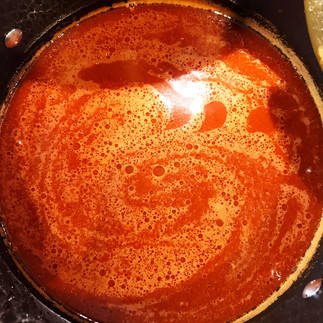
Look: The stock has a clear and bright color to the eye; the intense red color comes from the chili peppers sauce and the creaminess of the corn gives it more body.
Smell: The aroma is intense of spices and pork. Especially oregano, and garlic.
Flavor: The flavor is deep, very well balanced, the vegetables provide freshness, the corn and avocado have given it a spectacular creamy touch. The fat of the pork and the peanut are cut with the acidity of the lime. The spiciness of the chili and the radish are contrasted and potentiated with the other flavors.
About this experience:
The main challenge in creating this dish was the difficulty in getting fresh ingredients. Most are imported, canned and dried. I could not find the cuts of meat I wanted, such as pork backbone, legs, ears and pork trunk, since in my area the butchers do not have a great variety. My solution was to buy the most silimar cuts and try new things. It is difficult to recreate the authentic flavor when it is prepared in another country. Even so, I consider this dish a success, the taste exceeded my expectations and I am incredibly happy with the result. I would love to prepare different versions. Next time I will prepare a pozole with shrimp consommé and I would like to add green tomato to the recipe. This experience helped me not only practice one of my favorite meals, but also taught me not to close myself off to what I already know. It also taught me to have an open mind to use all kinds of ingredients, whether conventional or not. Next time I will venture further into the aisles of the supermarket to use brands that I have not tried and create new combinations. Creativity has no limits.
Citations:
Maria Scinto. (April 29, 2020). The Dark History Behind Pozole. October 3, 2021, from https://www.mashed.com/205804/the-dark-history-behind-pozole/
Enrique Ortiz. (September 16,2020). El origen del Pozole. October 3, 2021, from https://masdemx.com/2016/09/el-origen-del-pozole/
Yolotl, G.T. 2006. El Sacrificio Humano entre Los Mexicas. Inah, Mexico: Conaculta.

Ilustration by Mexico lindo® - https://www.facebook.com/UnMexicoLindo


Comments